

Bio-Rad Is Buying Its Way Into Digital PCR's Next Act. QIAGEN Is Building It In-House.
The two biggest names in digital PCR are taking opposite paths to the same goal, while a well-funded newcomer argues the whole category is about to be leapfrogged and a real-world Ebola outbreak quietly shows why the technology still matters.
Digital PCR has spent the past decade moving from a specialized research tool to a standard instrument in oncology and infectious disease labs. The more interesting story in 2025 and 2026 is not whether digital PCR keeps growing, but how its leading vendors are choosing to compete, and whether a new quantification technology might reshape the field before digital PCR's expansion is even finished. This article sets the market-sizing numbers in our companion report aside and looks at what has actually been moving.
Bio-Rad's Playbook: Acquire, Then Move Fast
In February 2025, Bio-Rad Laboratories entered a binding offer to acquire Stilla Technologies, a French and U.S. digital PCR developer best known for its Nio family of all-in-one systems. Rather than treating the acquisition as a slow integration project, Bio-Rad brought Stilla's technology to market within about five months, launching the QX700 series, built on the acquired platform, alongside its own newly developed QX Continuum system in July 2025. The QX700 series offers seven-color multiplexing and throughput of more than 700 samples per day, aimed squarely at academic research and biopharma quality control customers who need more automation and throughput than earlier digital PCR generations offered.
The speed of that launch suggests Stilla's platform was close to commercial readiness before the deal closed, and that Bio-Rad valued time to market enough to acquire rather than build the equivalent capability from scratch.
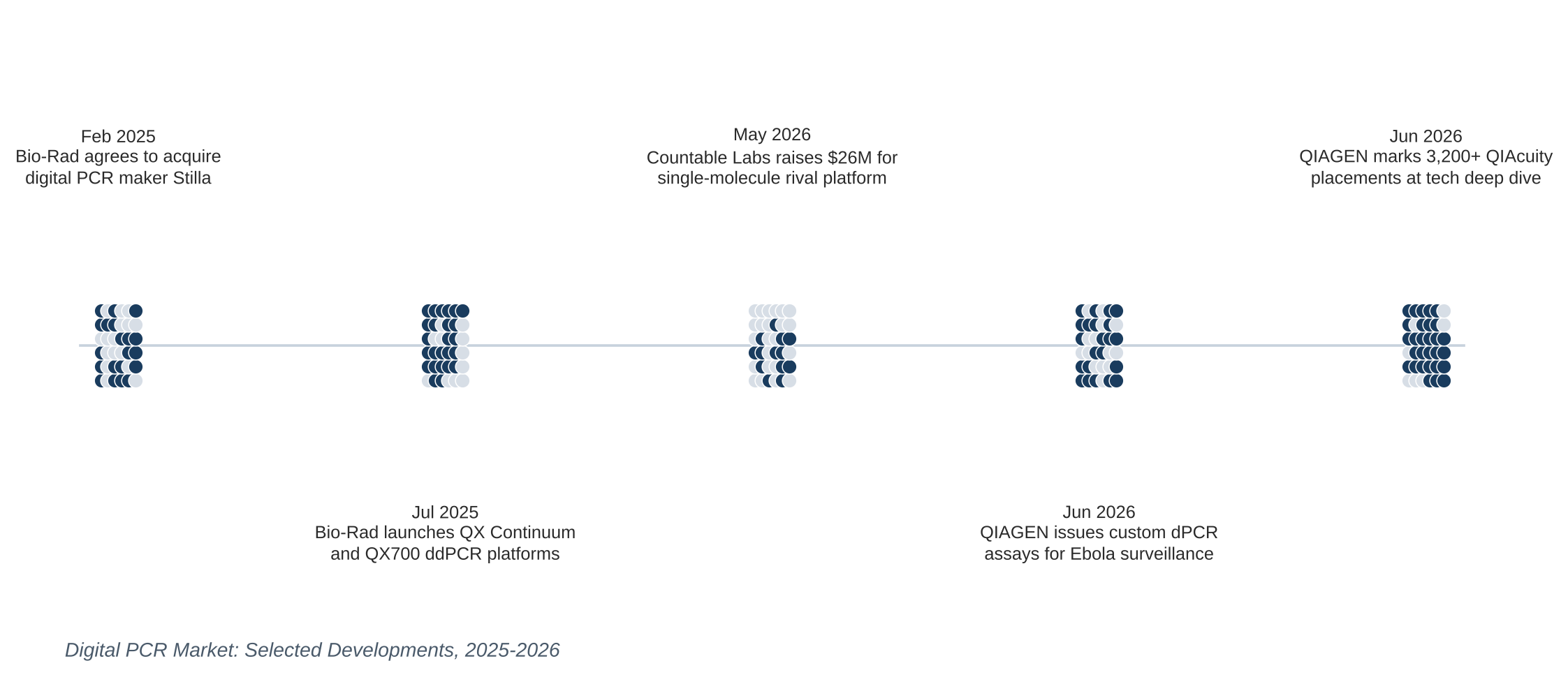
Figure 1. Selected dated developments in digital PCR, February 2025 through June 2026. Source: company and industry announcements cited throughout this article.
QIAGEN's Playbook: Deepen the Installed Base
QIAGEN has taken a visibly different path. At a June 2026 investor deep dive, the company reported more than 3,200 cumulative QIAcuity digital PCR placements worldwide and over 400 customers running multiple instruments, and announced new gene expression assays, a high-multiplex RNA kit, expanded cell and gene therapy quality control testing, and a Hamilton automation integration, all built onto its existing QIAcuity platform rather than acquired. The strategy reads as an attempt to deepen usage within an already large installed base rather than add new customers through acquisition.
A smaller but telling example of that installed base's value came two weeks earlier. In June 2026, QIAGEN made custom digital PCR assays available for research on the Bundibugyo ebolavirus outbreak, built from publicly released outbreak genomic sequences and designed to run on the existing QIAcuity platform. Digital PCR's defining advantage, absolute quantification without a standard curve, let QIAGEN move from public sequence data to a deployable assay quickly, a practical demonstration of why public health researchers keep reaching for the technology during outbreak response.
| Date | Development | Category |
|---|---|---|
| Feb 2025 | Bio-Rad agrees to acquire Stilla Technologies | Acquisition |
| Jul 2025 | Bio-Rad launches QX Continuum and QX700 platforms | Product Launch |
| Jun 2026 | QIAGEN reports 3,200+ QIAcuity placements at deep dive | Product Expansion |
Source: LabMedica (Feb 14, 2025); Business Wire via Tiger Brokers (Jul 7, 2025); QIAGEN (Jun 15, 2026).
A Well-Funded Bet That Digital PCR Is About to Be Leapfrogged
Not everyone is convinced digital PCR is the end state. Countable Labs raised an oversubscribed $26 million round in May 2026, led by ARCH Venture Partners, for a single-molecule quantification platform the company positions as outperforming digital PCR on sensitivity and precision, without needing the standard curves or Poisson correction digital PCR relies on. The company is targeting the same applications established digital PCR vendors already serve, including minimal residual disease testing and cell and gene therapy quality control.
The funding is a credible signal that investors see room for a technology positioned above digital PCR on performance, but it remains early-stage. Established digital PCR vendors have a multi-thousand-instrument installed base and years of clinical validation data that a new platform will need time to match, regardless of its underlying performance claims.
What to Watch
Three threads are worth tracking into the rest of 2026: whether Bio-Rad's acquire-and-launch approach to Stilla prompts similar consolidation moves by competitors, whether Countable Labs' single-molecule platform produces clinical validation data strong enough to pressure established digital PCR vendors, and whether digital PCR's role in the Bundibugyo ebolavirus response leads to broader public health procurement of the technology for future outbreak surveillance.
Digital PCR Market Report: Size, Share & Trends 2026–2035
This article provides editorial and R&D context only. For full market sizing, segmentation, regional share, competitive benchmarking and forecasts through 2035, see the companion Digital PCR Market report.
Get a free sample of this report
Digital PCR Market