

In Long-Acting Injectables, the Real Competition Is Over Dosing Interval
From a twice-yearly HIV prevention shot to a five-year contraceptive implant, approvals across the past eight months show manufacturers competing less on which drug they deliver and more on how rarely a patient has to come back.
Long-acting injectables have always promised one thing above everything else: fewer administrations. This article sets the market-sizing numbers in our companion report aside and looks at how that promise has played out across five separate developments since the middle of 2025, from a new record for dosing interval to a shift in who controls the delivery technology itself.
A Twice-Yearly Shot Resets the Bar
In June 2025, the FDA approved Gilead's Yeztugo (lenacapavir) as the first injectable option for HIV pre-exposure prophylaxis dosed only twice a year, offering up to six months of protection from a single subcutaneous administration. Most long-acting injectable options in other therapeutic areas still require monthly, bimonthly, or quarterly dosing, so a six-month interval sets a new reference point for how infrequently a long-acting injectable can be administered while still protecting patients between doses.
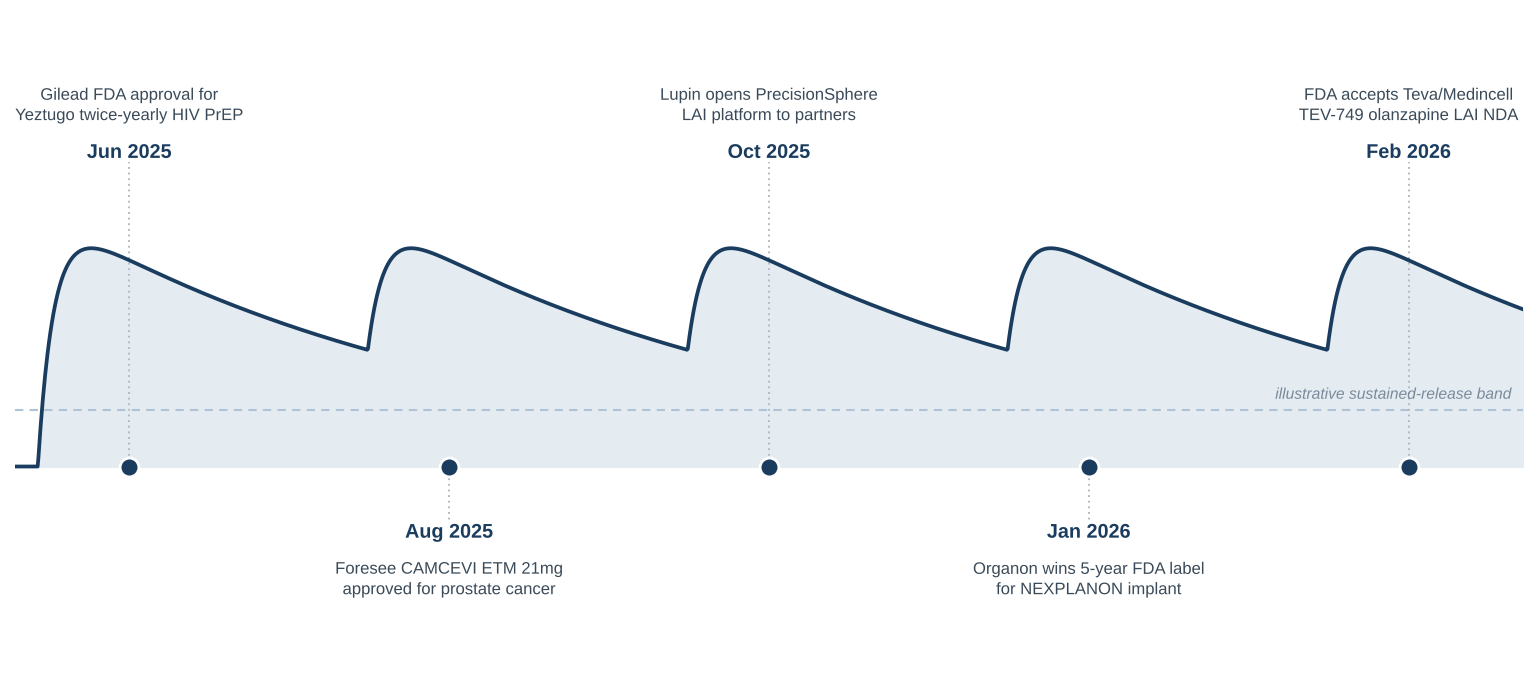
Figure 1. Selected dated developments in long-acting injectable pharmaceuticals, June 2025 through February 2026. Release curve is illustrative only. Source: company and industry announcements cited throughout this article.
Oncology and Contraception Are Pushing Dosing Intervals in Their Own Directions
Two approvals in this period show therapeutic areas extending dosing interval at a different pace than infectious disease. In August 2025, the FDA approved Foresee Pharmaceuticals' CAMCEVI ETM 21 mg, a ready-to-use leuprolide mesylate formulation dosed once every three months for advanced prostate cancer and licensed to Accord BioPharma for U.S. commercialization. In January 2026, the FDA approved a label extension for Organon's NEXPLANON contraceptive implant, raising its approved duration of use from three years to five, based on a study that reported no pregnancies in years four and five. The same approval introduced a new Risk Evaluation and Mitigation Strategy restricting insertion and removal to certified providers.
| Date | Development | Category |
|---|---|---|
| Jun 2025 | Gilead Yeztugo approved for twice-yearly HIV PrEP | Regulatory Approval |
| Aug 2025 | Foresee CAMCEVI ETM 21mg approved for prostate cancer | Regulatory Approval |
| Jan 2026 | Organon wins 5-year label for NEXPLANON implant | Regulatory Approval |
Source: Gilead Sciences (Jun 18, 2025); MedPath (Aug 29, 2025); Pharmacally (Jan 20, 2026).
The Delivery Technology Itself Is Becoming the Product
Not every development in this period was a drug approval. In October 2025, Lupin opened its PrecisionSphere long-acting injectable platform, developed by its subsidiary Nanomi B.V., to partnership with other drug developers seeking to extend product life cycles through sustained-release formulations, after the platform's first product had already received FDA approval. A similar dynamic appeared in February 2026, when the FDA accepted Teva and Medincell's New Drug Application for TEV-'749, a once-monthly olanzapine injectable built on Medincell's SteadyTeq copolymer technology. The companies said the Phase 3 SOLARIS trial, which reported no post-injection delirium or sedation events, could let the product avoid the REMS and monitoring requirements attached to existing long-acting olanzapine injections.
Taken together, these two developments point to delivery technology itself becoming a licensable asset in this market, with Nanomi's PrecisionSphere and Medincell's SteadyTeq each underpinning multiple drug programs from more than one company, rather than staying tied to a single branded product.
Long-Acting Injectable Pharmaceuticals Market Report: Size, Share & Trends 2026–2035
This article provides editorial and R&D context only. For full market sizing, segmentation, regional share, competitive benchmarking and forecasts through 2035, see the companion Long-Acting Injectable Pharmaceuticals Market report.
Get a free sample of this report
Long-Acting Injectable Pharmaceuticals Market