In Oligonucleotide Therapeutics, the Money Has Moved from Chemistry to Delivery
A $12 billion acquisition, a $250 million manufacturing bet, and a fresh Series B all point the same direction: getting an oligonucleotide molecule to work is no longer the hard part. Getting it to the right tissue, and making enough of it, is.
Antisense oligonucleotides and siRNA therapies have moved well past proof of concept. Multiple drugs in both classes are approved and generating meaningful revenue, and the chemistry behind them is well understood. What is less settled is where the next wave of value will come from, and the deals and investments from 2025 and 2026 suggest the field has largely agreed on an answer: delivery technology and manufacturing scale, not new target discovery, are where the competitive advantage now sits. This article sets the market-sizing numbers in our companion report aside and looks at what has actually been moving.
Novartis Pays $12 Billion for a Delivery Technology, Not a Drug
Novartis's agreement to acquire Avidity Biosciences for roughly $12 billion is notable less for Avidity's pipeline than for what it is built on. Avidity's antibody oligonucleotide conjugate technology attaches an oligonucleotide payload to an antibody that targets a specific cell type, in effect using the antibody as a delivery vehicle to reach muscle tissue, a historically difficult target for oligonucleotide therapies that mostly concentrate in the liver by default. Avidity's lead program, del-zota, targets Duchenne muscular dystrophy patients whose mutations are amenable to exon 44 skipping, with a regulatory filing expected around the time the deal was announced.
A deal of this size for a company still advancing its lead program through regulatory filing, rather than one already generating substantial commercial revenue, says something about how large pharmaceutical companies are valuing delivery platforms right now. The acquisition price is as much a bet on muscle-targeted delivery as a drug class as it is a bet on any single product.
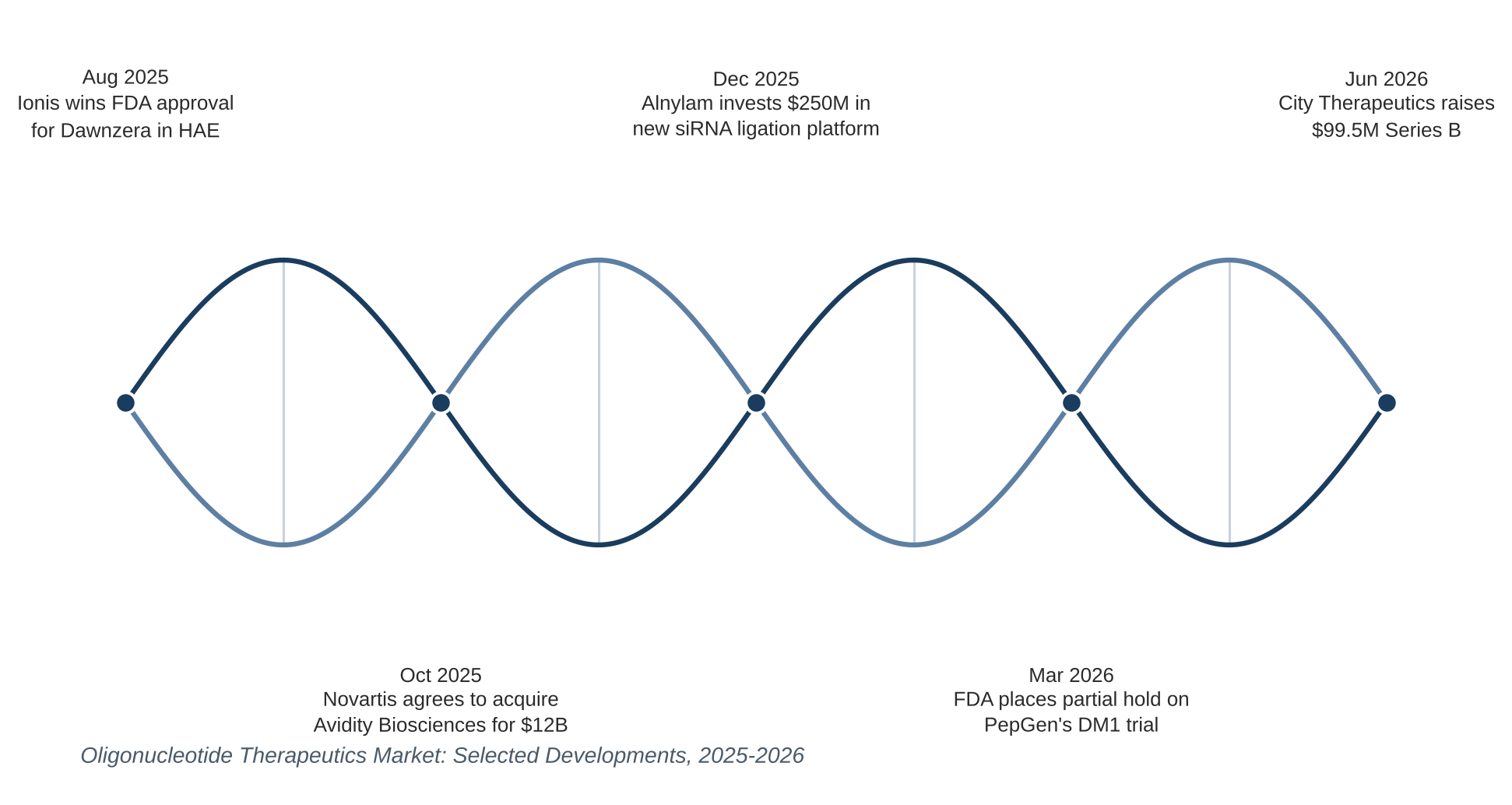
Figure 1. Selected dated developments in oligonucleotide therapeutics, August 2025 through June 2026. Source: company and regulatory announcements cited throughout this article.
Manufacturing Is Becoming a Visible Bottleneck
Alnylam's decision to invest $250 million in a new enzymatic ligation manufacturing platform at its Norton, Massachusetts facility points to a less visible but equally important constraint: making enough oligonucleotide drug substance to meet growing demand. The company's siRELIS platform joins shorter RNA fragments into complete siRNA molecules, using fewer starting materials and less solvent than conventional solid-phase synthesis, which the company says will meaningfully expand capacity and reduce production costs within the same facility footprint.
That Alnylam, already one of the largest commercial-stage RNAi companies, felt the need to invest in next-generation manufacturing technology rather than simply scaling existing methods suggests conventional oligonucleotide synthesis is approaching a capacity ceiling as more products reach commercial scale across the industry.
| Date | Development | Category |
|---|---|---|
| Oct 2025 | Novartis agrees to acquire Avidity Biosciences for ~$12B | Acquisition |
| Dec 2025 | Alnylam invests $250M in siRELIS manufacturing platform | Capacity Expansion |
| Jun 2026 | City Therapeutics raises $99.5M Series B | Funding |
Source: RTTNews (Oct 27, 2025); Business Wire (Dec 17, 2025); BioSpace (Jun 8, 2026).
A Clinical Hold That Was About Paperwork, Not Patients
In March 2026, the FDA placed a partial clinical hold on PepGen's Phase 2 FREEDOM2-DM1 trial of PGN-EDODM1, an oligonucleotide therapy for myotonic dystrophy type 1. The hold centered on questions about previously submitted preclinical pharmacology and toxicology studies, not on clinical safety data from the earlier Phase 1 trial. Dosing continued in Canada and the UK while PepGen worked to resolve the FDA's questions. The episode is a reminder that oligonucleotide programs can run into regulatory friction over chemistry and nonclinical data packages well after clinical proof of concept has been established.
Investors are still backing the broader field despite this kind of program-specific setback. City Therapeutics closed a $99.5 million Series B in June 2026 to advance siRNA delivery technology aimed at tissues beyond the liver, including an existing Biogen partnership for a central nervous system program worth up to $1 billion, suggesting that extrahepatic delivery remains one of the field's most closely watched frontiers.
What to Watch
Three threads are worth tracking into the rest of 2026: whether the Novartis-Avidity deal prompts similar acquisitions of other delivery-focused oligonucleotide companies, whether Alnylam's manufacturing investment is matched by competitors facing similar capacity constraints, and whether PepGen resolves its clinical hold quickly enough to keep its Duchenne and myotonic dystrophy programs on their original timelines.
Oligonucleotide Therapeutics Market Report: Size, Share & Trends 2026–2035
This article provides editorial and R&D context only. For full market sizing, segmentation, regional share, competitive benchmarking and forecasts through 2035, see the companion Oligonucleotide Therapeutics Market report.
Get a free sample of this report
Oligonucleotide Therapeutics Market