

Regenerative Medicine's Real Bottleneck Isn't the Science Anymore
Two genuinely different FDA approvals, South Korea's first patient treated under a new early-access law, and a deal built entirely around cutting manufacturing cost all point to the same place: the field has largely proven it can work. What it hasn't fully solved is how to get a treatment to a patient affordably and through a functioning regulatory path.
Regenerative medicine has spent years being judged mainly on scientific proof of concept: can a gene-corrected cell, an engineered tissue, or a reprogrammed cell type actually treat a disease that previously had no good options. By 2025 and 2026, for a growing list of conditions, the answer is clearly yes. What has moved to the center of attention instead is everything that has to work around that science: a regulatory pathway built for products this unusual, and a manufacturing process that does not collapse under its own cost. This article sets the market-sizing numbers in our companion report aside and looks at what has actually been moving.
Two Approvals, Two Completely Different Products
In March 2025, the FDA approved Encelto, the first therapy for macular telangiectasia type 2, a retinal disease that had no approved treatment. It works by implanting a small capsule of genetically engineered cells directly into the eye, where they continuously produce a therapeutic protein for as long as the implant remains in place. A few weeks later, in April 2025, the FDA approved Zevaskyn, made from a patient's own skin cells, genetically corrected and grown into sheets that are surgically grafted onto the chronic wounds caused by a rare, incurable skin disorder.
Neither product looks much like the other, and neither looks much like a CAR-T therapy or a traditional stem cell infusion. That is arguably the point. Regenerative medicine is no longer a single technology category with a few variants. It now spans implanted cell capsules, grafted engineered tissue, and a growing list of other product architectures, each built around whatever delivery method actually fits the disease being treated.
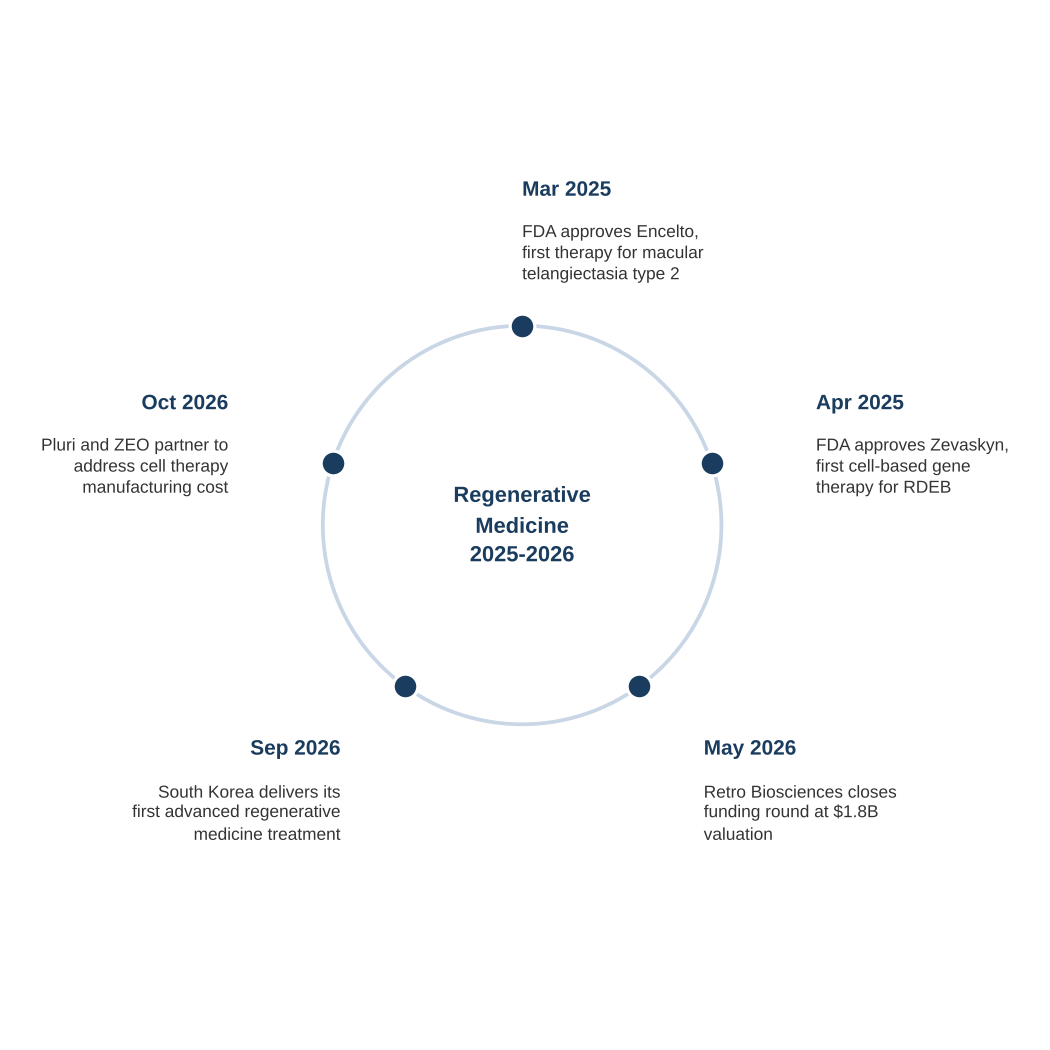
Figure 1. Selected dated developments in regenerative medicine, March 2025 through October 2026. Source: company and regulator announcements cited throughout this article.
An Early-Access Law Finally Reached an Actual Patient
South Korea introduced its advanced regenerative medicine treatment system in February 2025, a pathway designed to let eligible patients access promising regenerative therapies before they complete the full product approval process. It took more than eighteen months for that framework to produce an actual treated patient. In September 2026, a patient with a rare, high-relapse-risk lymphoma received the country's first treatment delivered under the new system, at Yeouido St. Mary's Hospital in Seoul.
The gap between a regulatory pathway taking effect and a patient actually being treated under it is a useful reminder that early-access frameworks are not self-executing. Japan's longer-running conditional approval system for regenerative medicine offers a reference point for how these pathways tend to mature once more products move through them, and South Korea's first case is worth watching as an early data point for how quickly its own system scales from here.
| Date | Development | Category |
|---|---|---|
| Mar 2025 | FDA approves Encelto, first therapy for macular telangiectasia type 2 | Regulatory approval |
| Apr 2025 | FDA approves Zevaskyn, first cell-based gene therapy for RDEB | Regulatory approval |
| Sep 2026 | South Korea delivers its first advanced regenerative medicine treatment | Regulatory milestone |
Source: Healio (Mar 6, 2025); GlobeNewswire (Apr 29, 2025); Seoul Economic Daily (Sep 22, 2026).
The $400,000 Problem Nobody Has Fully Solved
Scientific proof of concept does not automatically produce a commercially sustainable product. Autologous cell therapies, made from each individual patient's own cells, generally require a completely separate manufacturing batch and quality testing process for every single dose, which can push per-treatment cost above $400,000, with labor alone accounting for roughly half of that figure. Because this kind of manufacturing scales out rather than up, adding more machines and more staff rather than simply running a larger batch, costs tend to stay stubbornly high even as a therapy matures.
An October 2026 deal between Pluri and ZEO ScientifiX was built specifically around that problem, pairing Pluri's industrial cell-expansion manufacturing technology with ZEO's existing physician distribution network in an effort to make manufacturing economics, not just clinical results, a deliberate deal rationale. More activity like this, explicitly organized around manufacturing cost rather than around discovering a new therapeutic target, looks likely as more regenerative products reach the market and face the same structural cost pressure.
Capital Is Still Betting on the Harder, Longer-Term Science
Not all of the field's momentum is in products already close to patients. In May 2026, longevity-focused regenerative medicine startup Retro Biosciences closed a funding round at a $1.8 billion valuation, backing a pipeline that includes stem cell programs still in preclinical development and AI-assisted research into cell reprogramming. Investors underwriting a company years away from a marketed product suggests real confidence that the underlying science, not just the near-term pipeline, remains worth funding.
Taken together, the approvals, the regulatory milestone, and the manufacturing deal all point in the same direction: regenerative medicine's central question has shifted from whether the science works to whether the surrounding system, regulatory pathways and manufacturing economics alike, can keep up with it.
Regenerative Medicine Market Report: Size, Share & Trends 2026–2035
This article provides editorial and R&D context only. For full market sizing, segmentation, regional share, competitive benchmarking and forecasts through 2035, see the companion Regenerative Medicine Market report.
Get a free sample of this report
Regenerative Medicine Market