

RNA Therapeutics Grow Up: From One Famous Vaccine Platform to a Whole Drug Class
A hemophilia approval, a $2.4 billion circular RNA acquisition, and a quiet US manufacturing build-out all point the same direction: RNA therapeutics are no longer a single pandemic-era technology but a genuinely diversified drug class with its own trade-offs and open questions.
Mention RNA therapeutics and most people still picture one thing: the mRNA vaccines that reached hundreds of millions of people during the pandemic. That picture is now badly out of date. Across the past two years, the more interesting developments in this market have come from siRNA and antisense oligonucleotide therapies reaching patients with chronic, specialized conditions, from large pharmaceutical companies paying billions to acquire RNA delivery platforms outright, and from a slower, less visible buildout of the manufacturing capacity the entire category depends on. This article sets the market-sizing numbers in our companion report aside and looks at what has actually been moving.
The Quiet Rise of siRNA and Antisense Therapies
While mRNA vaccines dominated public attention, siRNA and antisense oligonucleotide therapies were steadily racking up approvals in rare and chronic diseases, often with far less fanfare. In March 2025, the FDA approved Qfitlia (fitusiran), the first siRNA-based therapy for hemophilia A or B, extending RNA interference technology into a bleeding disorders market far larger than the rare metabolic conditions where siRNA first found approval. A year later, Ionis won an expanded FDA approval for Tryngolza (olezarsen), an antisense oligonucleotide originally approved for a rare lipid disorder, to treat the much more common severe hypertriglyceridemia.
The pattern in both cases is the same: a therapy proves itself in a narrow, often ultra-rare indication, then expands into a larger population once real-world safety and efficacy data accumulate. That expansion path has become one of the more predictable ways RNA therapeutics companies grow revenue without needing an entirely new regulatory approval from scratch.
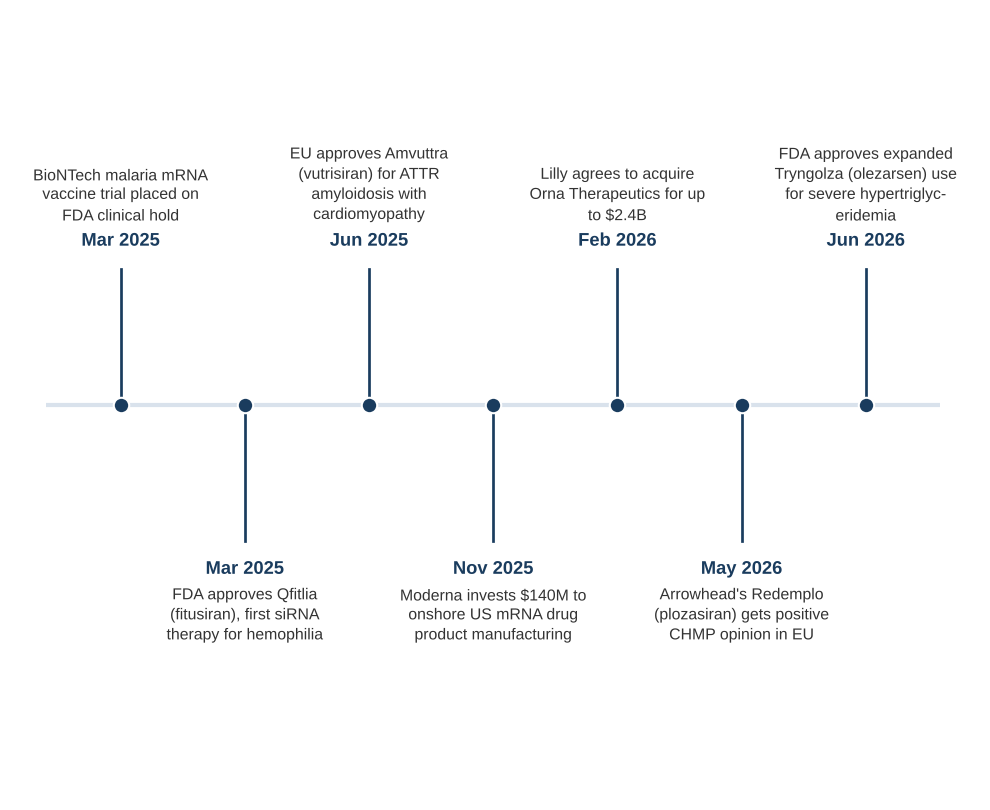
Figure 1. Selected dated developments in RNA therapeutics, March 2025 through June 2026. Source: company and regulator announcements cited throughout this article.
Big Pharma Is Buying Its Way Into RNA Engineering
Eli Lilly's agreement in February 2026 to acquire Orna Therapeutics for up to $2.4 billion is a useful marker of how large pharmaceutical companies are choosing to approach RNA therapeutics. Rather than building circular RNA and in vivo cell engineering capability internally, Lilly bought it, gaining Orna's engineered circular RNA platform and a clinical-ready in vivo CAR-T program for autoimmune disease along with it. The rationale Lilly gave was direct: current cell therapies are complex, costly, and hard to deliver to a broad patient population, and an in vivo approach built on RNA delivery could change that math.
This is not an isolated deal. The technical complexity of RNA drug design, delivery engineering, and manufacturing has made acquisition a faster route to differentiated capability than internal research for companies with the balance sheet to pay for it, a dynamic likely to keep consolidating specialized RNA platform companies into larger organizations over the next several years.
| Date | Development | Category |
|---|---|---|
| Mar 2025 | FDA approves Qfitlia (fitusiran), first siRNA therapy for hemophilia | Regulatory approval |
| Nov 2025 | Moderna invests $140M to onshore US mRNA manufacturing | Manufacturing |
| Feb 2026 | Lilly agrees to acquire Orna Therapeutics for up to $2.4B | Acquisition |
Source: Sanofi (Mar 28, 2025); Manufacturing Chemist (Nov 2025); Eli Lilly (Feb 9, 2026).
Manufacturing Capacity Is the Story Nobody's Tweeting About
Moderna's November 2025 announcement of a $140 million investment to onshore its remaining mRNA drug product manufacturing at its Norwood, Massachusetts campus received far less attention than any product approval, but it reflects a strategic shift the whole category is working through. The project will complete an end-to-end domestic mRNA manufacturing network able to serve both commercial and clinical needs, with completion targeted for the first half of 2027.
Lipid nanoparticle formulation, the delivery technology behind most approved mRNA and a growing share of siRNA products, remains concentrated among a relatively small number of specialized manufacturers. That concentration is part of why companies across the category, not just Moderna, have been investing in redundant, geographically distributed manufacturing capacity rather than relying on a single site or region, a lesson drawn largely from the supply constraints of the pandemic's early years.
What a Clinical Hold on a Malaria Vaccine Says About the Category's Maturity
It would be easy to read every RNA therapeutics headline as a success story, so it is worth noting one that was not. In March 2025, the FDA placed a clinical hold on BioNTech's BNT165e, an mRNA vaccine candidate in early-stage trials aimed at preventing blood-stage malaria infection. BioNTech said it was complying with the hold and working with the agency on its requests, without disclosing the underlying reason.
The hold is a useful counterweight to the acquisition and approval headlines above. Even an experienced mRNA developer with a commercially proven platform faces the same clinical-stage safety scrutiny as any other investigational biologic once a program moves into human trials for a new indication. RNA therapeutics have matured enough to have both big wins and ordinary regulatory setbacks in the same two-year window, which is itself a sign of a category settling into a more normal drug development rhythm.
RNA Therapeutics Market Report: Size, Share & Trends 2026–2035
This article provides editorial and R&D context only. For full market sizing, segmentation, regional share, competitive benchmarking and forecasts through 2035, see the companion RNA Therapeutics Market report.
Get a free sample of this report
RNA Therapeutics Market