

Roche Just Paid Over a Billion Dollars to Prove Digital Pathology Is No Longer About Scanning Slides
A billion-dollar acquisition, a new Medicare billing code for AI algorithms, and a quality control tool that catches scanning errors before they happen all point to the same shift: the money in digital pathology has moved from the scanner to the software running on top of it.
For most of its history, digital pathology was fundamentally a digitization story. Glass slides got scanned into high-resolution images, those images got stored and shared instead of physically mailed between labs, and pathologists reviewed cases on a monitor instead of through a microscope. That story is still true, but it is no longer the interesting one. Over the past two years, the more consequential developments have been about what happens after a slide is digitized: who gets paid to analyze it with AI, and how much that analysis is worth. This article sets the market-sizing numbers in our companion report aside and looks at what has actually been moving.
A Billion-Dollar Bet That AI Pathology Is Worth Owning
Roche's agreement in May 2026 to acquire PathAI for up to $1.05 billion, including $750 million upfront and up to $300 million in milestone payments, is the clearest signal yet of how a major diagnostics company values AI-native pathology capability. Roche already has deep strength in companion diagnostics and oncology testing. Rather than building equivalent AI modeling capability internally, it chose to buy a company that had already built it, with the stated plan to combine PathAI's tools with Roche's existing diagnostics platforms and scale the technology globally.
The deal followed a smaller but directionally similar move a year earlier: Danaher's Leica Biosystems unit partnering with AstraZeneca in May 2025 to build new precision medicine diagnostic tests on a foundation of digital and computational pathology technology. Large diagnostics and pharmaceutical companies appear to be converging on the same conclusion from different directions, that AI-based pathology analysis is becoming a core capability worth owning or partnering deeply into, not a feature to bolt on later.
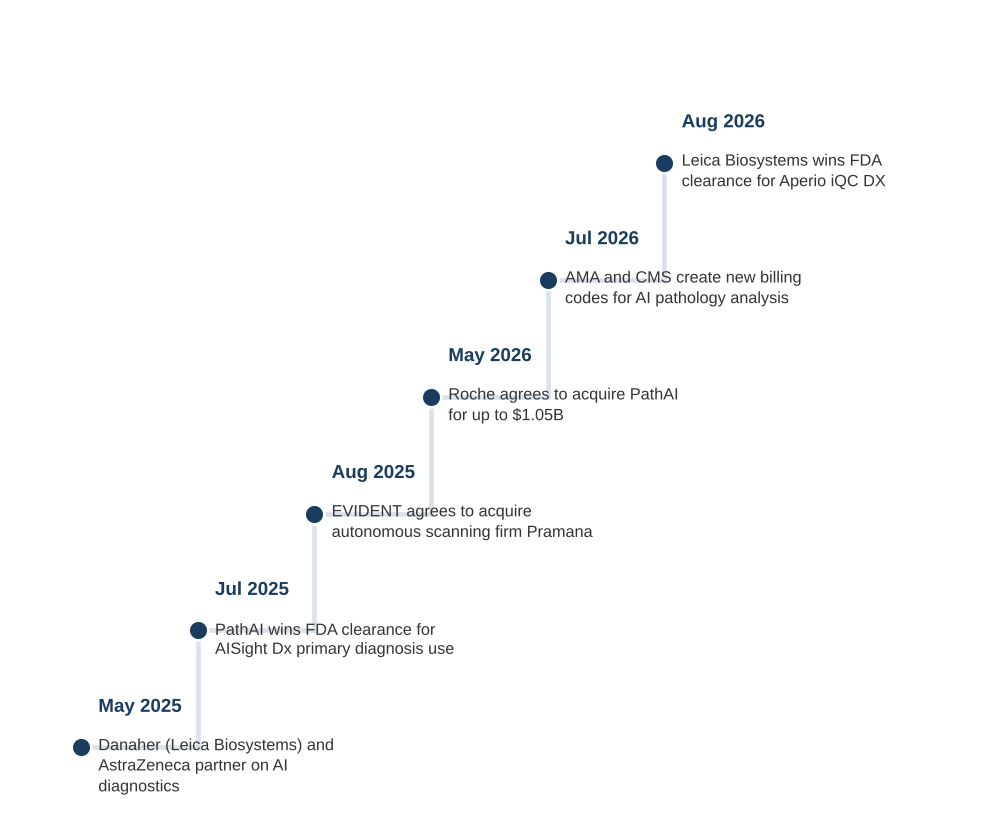
Figure 1. Selected dated developments in digital pathology, May 2025 through August 2026. Source: company and regulator announcements cited throughout this article.
Medicare Just Created a Price Tag for AI Analysis
The more technical, less headline-grabbing development may ultimately matter more. In July 2026, the AMA published new Category III CPT codes covering AI-based algorithmic analysis of digital pathology slides across bladder, pancreatic, breast, and prostate cancer, each reporting specific prognostic or treatment-response parameters. CMS followed with proposed payment rates and moved the codes off the standard clinical lab fee schedule entirely.
That distinction matters. A billing code specific to algorithmic analysis, priced separately from conventional slide interpretation, is Medicare effectively agreeing that AI analysis of a pathology slide is a distinct service worth paying for on its own terms. Category III codes are temporary and used to track emerging technology before a permanent code is considered, so this is an early signal rather than a settled policy, but it is the clearest reimbursement pathway digital pathology AI has had to date.
| Date | Development | Category |
|---|---|---|
| Jul 2025 | PathAI wins FDA clearance for AISight Dx primary diagnosis use | Regulatory approval |
| Aug 2025 | EVIDENT agrees to acquire autonomous scanning firm Pramana | Acquisition |
| May 2026 | Roche agrees to acquire PathAI for up to $1.05B | Acquisition |
Source: MLO (Jul 1, 2025); News-Medical (Aug 13, 2025); MedTech Dive (May 7, 2026).
Hardware Consolidation Hasn't Stopped, It's Just Gotten Quieter
It would be easy to read the AI dealmaking and conclude that scanner hardware no longer matters much. EVIDENT's August 2025 agreement to acquire Pramana, a maker of fully autonomous whole slide scanning systems, argues otherwise. Autonomous, largely unattended scanning workflow remains a genuine operational bottleneck for laboratories trying to digitize slides at scale, particularly given global shortages of trained pathologists and laboratory technicians in many markets.
A year later, Leica Biosystems' August 2026 FDA clearance for Aperio iQC DX, described as the first FDA-cleared AI-assisted quality control software for digital pathology in clinical use, made a similar point from a different angle. The software flags common scanning problems such as air bubbles and out-of-focus areas before a slide leaves the scanner, catching errors that would otherwise require a costly rescan. AI in this market is not only about diagnosis and prognosis. Some of the most practical near-term AI applications are about making the unglamorous parts of a pathology lab's workflow run with fewer errors.
What's Next: Foundation Models Without a Clear Regulatory Path
The next frontier in this market is foundation models trained across dozens or more than a hundred distinct pathology tasks at once, rather than narrow tools built for a single clinical question. That is a meaningfully different proposition from a product like PathAI's AISight Dx, which was cleared for a specific, bounded use. Existing device clearance frameworks were generally built around evaluating one clear clinical claim at a time, and it remains an open question how regulators will evaluate a model built to handle dozens of different tasks across many cancer types and clinical questions at once.
That gap between what the technology can now do and what the regulatory system knows how to evaluate is likely to be one of the more interesting threads to watch in digital pathology over the next few years, separate from and in some ways more complicated than the reimbursement and consolidation stories above.
Digital Pathology Market Report: Size, Share & Trends 2026–2035
This article provides editorial and R&D context only. For full market sizing, segmentation, regional share, competitive benchmarking and forecasts through 2035, see the companion Digital Pathology Market report.
Get a free sample of this report
Digital Pathology Market