

The Slowest Step in Making a Biologic Just Got a Software Upgrade
A royalty-free licensing kit, an AI-driven design platform now running at a major Korean drugmaker, and a private equity-backed CDMO spinoff all point to the same shift: the unglamorous work of building a production cell line is becoming a genuine battleground for differentiation, not just a procurement checkbox.
Before a single vial of a biologic drug can be manufactured, someone has to build the cell line that makes it. That process, taking a gene of interest, inserting it into a host cell, and screening thousands of resulting clones to find the rare one that produces enough protein, consistently, at commercial scale, has traditionally been one of the slowest and most manual steps in getting a biologic from idea to clinic. Over the past eighteen months, that has started to change in ways that go beyond the usual incremental titer improvements vendors advertise every year. This article sets the market-sizing numbers in our companion report aside and looks at what has actually been moving.
AI-Assisted Design Just Landed at a Major Biologics Developer
In October 2026, Asimov announced that LG Chem would in-license its CHO Edge System, including Kernel, the company's AI-driven genetic design software, to support the Korean company's next-generation biologics work. The deal followed an earlier move in April 2025, when Asimov and Cytiva jointly launched an integrated cell line development and process development service built around the same underlying platform, pairing computational genetic design with Cytiva's established media and process development capabilities.
Taken together, the two announcements suggest something more durable than a single vendor's marketing push. A major biologics manufacturer choosing to license AI-driven genetic design software, rather than relying purely on empirical trial and error across thousands of clones, is a real signal about where the industry expects cell line development work to go as drug pipelines increasingly include harder-to-express molecule formats such as multispecific antibodies and fusion proteins.
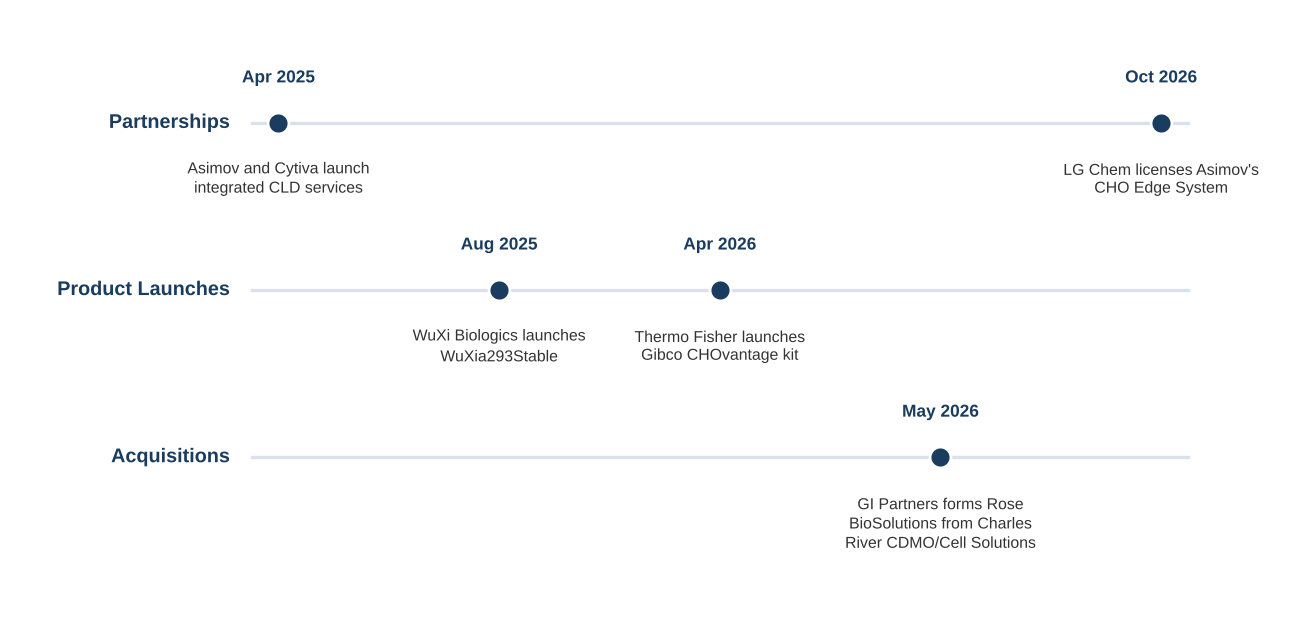
Figure 1. Selected dated developments in cell line development, grouped by development type, April 2025 through October 2026. Source: company announcements cited throughout this article.
Licensing Terms Are Becoming a Selling Point, Not Just Fine Print
A separate but related shift is happening around how cell line platforms are licensed, not just how well they perform. Thermo Fisher's April 2026 launch of the Gibco CHOvantage GS Cell Line Development Kit pairs titers of 7 grams per liter or higher with royalty-free, clinical-stage licensing options, a direct response to a long-running complaint from biologics developers about downstream royalty and milestone payments tied to some competing platforms once a program advances toward commercialization.
That licensing structure matters more than it might first appear. A platform selection decision made early in development can carry royalty obligations for the life of a commercial product, so a vendor removing that uncertainty entirely can compete on terms as much as on raw titer numbers, a dynamic that was far less visible in how cell line platforms were marketed even two or three years ago.
| Date | Development | Category |
|---|---|---|
| Aug 2025 | WuXi Biologics launches WuXia293Stable, a HEK293-based platform for difficult-to-express biologics | Product launch |
| Apr 2026 | Thermo Fisher launches the royalty-free Gibco CHOvantage GS Cell Line Development Kit | Product launch |
| May 2026 | GI Partners forms Rose BioSolutions from Charles River's CDMO and Cell Solutions businesses | Acquisition |
Source: Pharmaceutical Manufacturing (Aug 12, 2025); MarketScreener (Apr 1, 2026); PR Newswire (May 7, 2026).
The CDMO Map Is Being Redrawn Through Spinoffs, Not Just Mergers
In May 2026, private equity firm GI Partners completed its acquisition of Charles River Laboratories' Contract Development and Manufacturing Organization and Cell Solutions businesses, relaunching them as an independent company, Rose BioSolutions. The move is a reminder that consolidation in this market does not only run in one direction. Large, diversified life sciences companies are also choosing to carve cell and gene therapy manufacturing assets out into focused, independently capitalized businesses rather than keep investing in them inside a much larger corporate parent.
Whether that structural separation accelerates investment in cell line development capacity, since a focused standalone company can direct capital specifically toward that segment without competing against a parent's other business lines, is one of the more interesting threads to watch as Rose BioSolutions builds out its own identity in the market.
Beyond CHO: The Default Host Cell Line Is Getting Company
For decades, Chinese hamster ovary cells have been the default host for producing complex biologics, valued for their human-like post-translational modification capability. WuXi Biologics' WuXia293Stable platform, launched in August 2025, makes a different bet, building a HEK293-based system specifically aimed at molecules that have historically struggled with low titers or quality issues in standard CHO systems.
None of this suggests CHO is losing its dominant position anytime soon. But a market that has long treated CHO as close to a default choice is beginning to support a more varied toolkit, matched to a specific biologic's expression challenges rather than a one-size-fits-all approach, a trend likely to become more visible as multispecific and fusion-format molecules make up a larger share of development pipelines.
Cell Line Development Market Report: Size, Share & Trends 2026–2035
This article provides editorial and R&D context only. For full market sizing, segmentation, regional share, competitive benchmarking and forecasts through 2035, see the companion Cell Line Development Market report.
Get a free sample of this report
Cell Line Development Market