

The Smart Inhaler Story Isn't About the Sensor Anymore, It's About Who Pays for the Data
A new FDA clearance, a cautious NICE recommendation, and a small Australian company's shipment numbers all point to the same conclusion: the technology behind connected inhalers has been ready for years. What changed recently is who gets paid, and how much usage data it takes to bill for it.
Connected inhaler sensors are not new. Add-on devices that clip onto an inhaler and log when it is used have existed in various forms for close to a decade. What has actually shifted over the past two years is less visible than a new sensor or app feature: changes to how remote monitoring of inhaler use gets paid for, and a more cautious, evidence-first posture from regulators deciding whether to recommend these tools for routine use. This article sets the market-sizing numbers in our companion report aside and looks at what has actually been moving in the smart inhalers space.
Another Cleared Sensor, a More Crowded Field
In October 2025, Aptar Digital Health received FDA 510(k) clearance for HeroTracker Sense, a Bluetooth-enabled sensor that attaches to pressurized metered dose inhalers to track usage and give patients feedback on their inhaler technique through a companion app. On its own, the clearance is unremarkable. It is one of several similar add-on sensors now cleared for a similar purpose, and the underlying sensing technology, detecting an inhaler actuation and estimating inhalation flow, is no longer a meaningful technical differentiator between competitors.
What differentiates these products now is less about the hardware and more about the software experience, the clinical partnerships that get a device into a patient's hands, and whether the resulting usage data can actually be billed to a payer. A cleared sensor is a prerequisite for competing in this market, not a competitive advantage by itself.
A Billing Code Change Did More Than a New Feature Could
The clearest evidence that reimbursement, not technology, is driving this market came from Adherium, a small Australian company that makes the Hailie Smartinhaler platform. In a March 2026 update, the company reported that new US CPT billing codes, which took effect in January 2026 and lower the amount of patient usage data required each month to bill for remote patient monitoring, had helped drive a 51 percent jump in its quarterly remote monitoring revenue. Cumulative device shipments grew 43 percent over the same period.
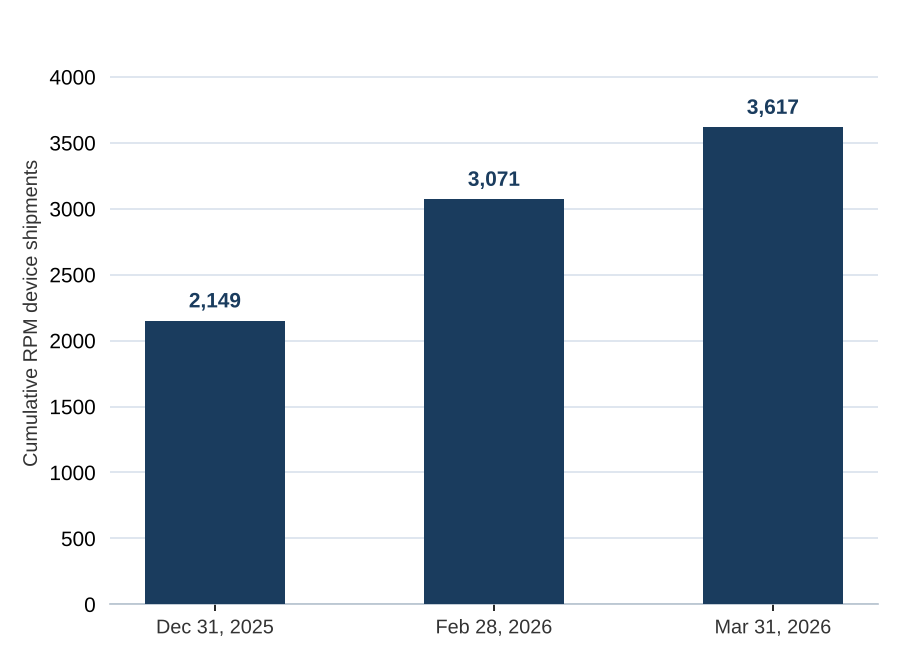
Figure 1. Adherium's cumulative Hailie Smartinhaler remote patient monitoring device shipments, December 2025 through March 2026. Source: Adherium Limited ASX filings, March 10, 2026 and April 29, 2026.
A billing code is not a headline most patients or clinicians will ever notice. But a lower data threshold for monthly reimbursement directly changes the economics of running a remote monitoring program, making it viable for a wider range of patients than a stricter threshold would allow. That kind of change tends to move the needle on adoption more than a marginally better sensor ever could.
Regulators Are Choosing to Wait and Watch, Not Decide Outright
The UK's National Institute for Health and Care Excellence took a notably cautious approach in January 2026, issuing draft guidance that recommends eight digital asthma management platforms for use within the NHS, but only during a three-year evidence-generation period rather than as a final, unconditional recommendation. NICE will review additional real-world outcomes data gathered during that window before deciding whether the platforms earn routine NHS adoption.
That kind of conditional, watch-and-decide-later approach is becoming more common across health systems evaluating digital health tools generally, not just connected inhalers. It reflects a reasonable regulatory instinct: a single clinical trial often cannot capture whether a digital adherence tool actually changes outcomes at scale, so letting real-world use generate that evidence before committing to permanent coverage reduces the risk of locking in a tool that does not deliver.
| Date | Development | Category |
|---|---|---|
| Oct 2025 | Aptar Digital Health wins FDA clearance for HeroTracker Sense | Regulatory approval |
| Jan 2026 | NICE recommends 8 digital asthma platforms for 3-year NHS evidence period | Regulatory guidance |
| Mar 2026 | New US CPT codes help drive 51% jump in Adherium's RPM revenue | Reimbursement |
Source: Aptar Digital Health (Oct 16, 2025); Healthcare Management UK (Jan 7, 2026); Adherium Limited (Mar 10, 2026).
The Propellant Question Nobody's Rushing to Answer
Most smart inhalers on the market today are add-on sensors built to work with conventional metered dose inhalers, which still rely on hydrofluorocarbon propellants. In August 2025, the EPA renewed priority access to those propellant allowances through 2030, finding that no safe or technically achievable substitute has yet been approved by the FDA for use in an MDI. Europe has been moving somewhat faster on a transition to lower global-warming-potential propellants, creating a regulatory gap between the two regions that connected device manufacturers will need to navigate as they plan which inhaler hardware their sensors are built to support.
None of this changes what a smart inhaler sensor does today. But it is a reminder that add-on sensor manufacturers are, in a sense, tenants on hardware they do not control. A future propellant reformulation, whenever it eventually happens, could require a new generation of sensor designs built for inhaler canisters that do not yet exist.
Smart Inhalers Market Report: Size, Share & Trends 2026–2035
This article provides editorial and R&D context only. For full market sizing, segmentation, regional share, competitive benchmarking and forecasts through 2035, see the companion Smart Inhalers Market report.
Get a free sample of this report
Smart Inhalers Market