

Tariffs Are Changing Nonwoven Sourcing While Acquisitions Are Changing Who Makes the Products
A tariff increase on Chinese fabric imports and three acquisitions across the supply chain, from a UK fabric maker to a US distributor to a Chinese wound care manufacturer, show medical nonwoven supply reshaping on two fronts at once.
Medical nonwoven products sit at the intersection of trade policy and supply chain consolidation in a way few other medical device categories do, because so much of the underlying fabric is imported and because the finished products pass through several layers of manufacturing and distribution before reaching a hospital. This article sets the market-sizing numbers in our companion report aside and looks at what has actually changed in sourcing costs and company ownership over the past year and a half.
Tariffs Are Changing the Sourcing Calculus
The United States raised tariffs on Chinese nonwoven fabric imports twice within a single month, first to 10% on February 4, 2025 and then to 20% on March 4, 2025. China remained the largest single source of US nonwoven fabric imports by volume even after the increases, but the higher duties were expected to narrow its cost advantage relative to exporters in Taiwan, Thailand, and Turkiye. For buyers of nonwoven surgical gowns, drapes, and masks, the practical choice is between absorbing the added cost, passing it on, or shifting part of their sourcing to a different country, and each option carries its own trade-off in price, lead time, or supplier qualification work.
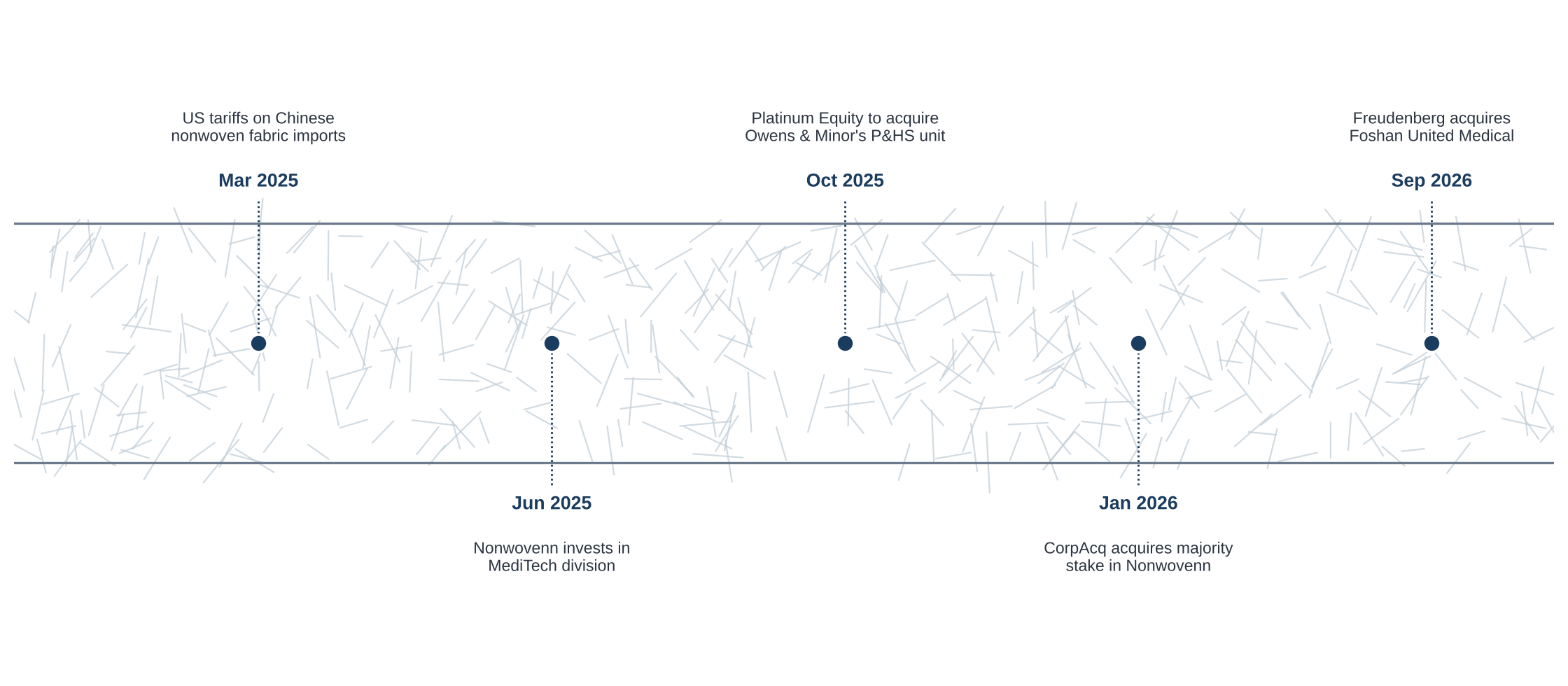
Figure 1. Selected dated developments in medical nonwoven products, March 2025 through September 2026. Source: company and industry announcements cited throughout this article.
One Manufacturer's Path From Self-Investment to Acquisition Target
Nonwovenn, a UK nonwoven fabric manufacturer serving medical, hygiene, and industrial customers, invested in a new medical manufacturing suite, including a Class 8 cleanroom, at its Bridgwater headquarters in June 2025. The investment, partly funded by a key customer, supported a three-year plan targeting 14% year-on-year growth for its MediTech division, which makes products including X-ray detectable surgical materials and reinforced wound care dressings. Seven months later, in January 2026, CorpAcq acquired a majority stake in Nonwovenn. CorpAcq, which specializes in acquiring small and medium-sized enterprises, said it plans to use Nonwovenn as a platform for further technical textiles acquisitions, so the growth plan Nonwovenn funded itself in mid-2025 became part of the case for acquiring the company only months later.
| Date | Development | Category |
|---|---|---|
| Jun 2025 | Nonwovenn invests in new MediTech manufacturing suite | Capacity Investment |
| Jan 2026 | CorpAcq acquires majority stake in Nonwovenn | Acquisition |
| Sep 2026 | Freudenberg acquires Foshan United Medical | Acquisition |
Source: Textile World (Jun 24, 2025); Textile Technology (Jan 20, 2026); Textile World (Sep 4, 2026).
Consolidation Is Happening on Both Sides of the Supply Chain
The same eighteen-month period also brought acquisitions outside fabric manufacturing. In October 2025, Platinum Equity agreed to acquire the Products & Healthcare Services segment of Owens & Minor, a vertically integrated distributor that supplies nonwoven surgical and infection control products to hospitals and health systems, with Owens & Minor retaining a 5% stake in the divested business. That deal sits at the distribution layer of the supply chain, separate from the fabric and finished-product consolidation happening elsewhere.
In September 2026, Freudenberg Performance Materials acquired Foshan United Medical, a China-based advanced wound care manufacturer with integrated capabilities spanning fiber production, nonwoven manufacturing, sterilization, and marketing authorization. The acquired company's product line includes polyurethane foam dressings, silicone-coated dressings, and silver-containing antimicrobial dressings, giving Freudenberg manufacturing capacity in a geography and product category that extends its existing wound care portfolio rather than duplicating it.
Medical Nonwoven Products Market Report: Size, Share & Trends 2026–2035
This article provides editorial and R&D context only. For full market sizing, segmentation, regional share, competitive benchmarking and forecasts through 2035, see the companion Medical Nonwoven Products Market report.
Get a free sample of this report
Medical Nonwoven Products Market