

Thermo Fisher Is Covering Every Cell Type. Smaller Media Makers Are Betting on the Gaps It Leaves Behind.
A wave of chemically defined media launches shows one supplier racing across CHO and E. coli platforms at once, while specialized firms stake out animal-free formulations, GMP-grade services, and stem cell media as separate businesses.
Serum-free and chemically defined cell culture media has been moving away from animal-derived components for years, driven by regulatory pressure and the need for more consistent, scalable production. The more interesting story in 2025 and into 2026 is not that shift itself, but how differently suppliers of different sizes are positioning around it. This article sets the market-sizing numbers in our companion report aside and looks at what has actually been launched, partnered, and funded.
One Supplier, Two Cell Types, Three Months Apart
Thermo Fisher launched two distinct chemically defined media products within a few months of each other. In September 2025, the company introduced Gibco Efficient-Pro Medium (+) Insulin, built for insulin-dependent CHO cell lines used in monoclonal antibody and biosimilar production, claiming up to 61% higher protein yields than alternative media while removing the need for manual insulin supplementation. By December 2025, Thermo Fisher had expanded its Gibco Bacto portfolio with two new E. coli-focused products aimed at plasmid DNA and recombinant protein production, a different cell type serving a different part of the biomanufacturing pipeline.
Launching chemically defined media for both a mammalian cell line and a microbial system in the same quarter-to-quarter window suggests a strategy built on breadth: covering as many cell types and manufacturing modalities as possible under one brand, rather than concentrating engineering effort on a single platform.
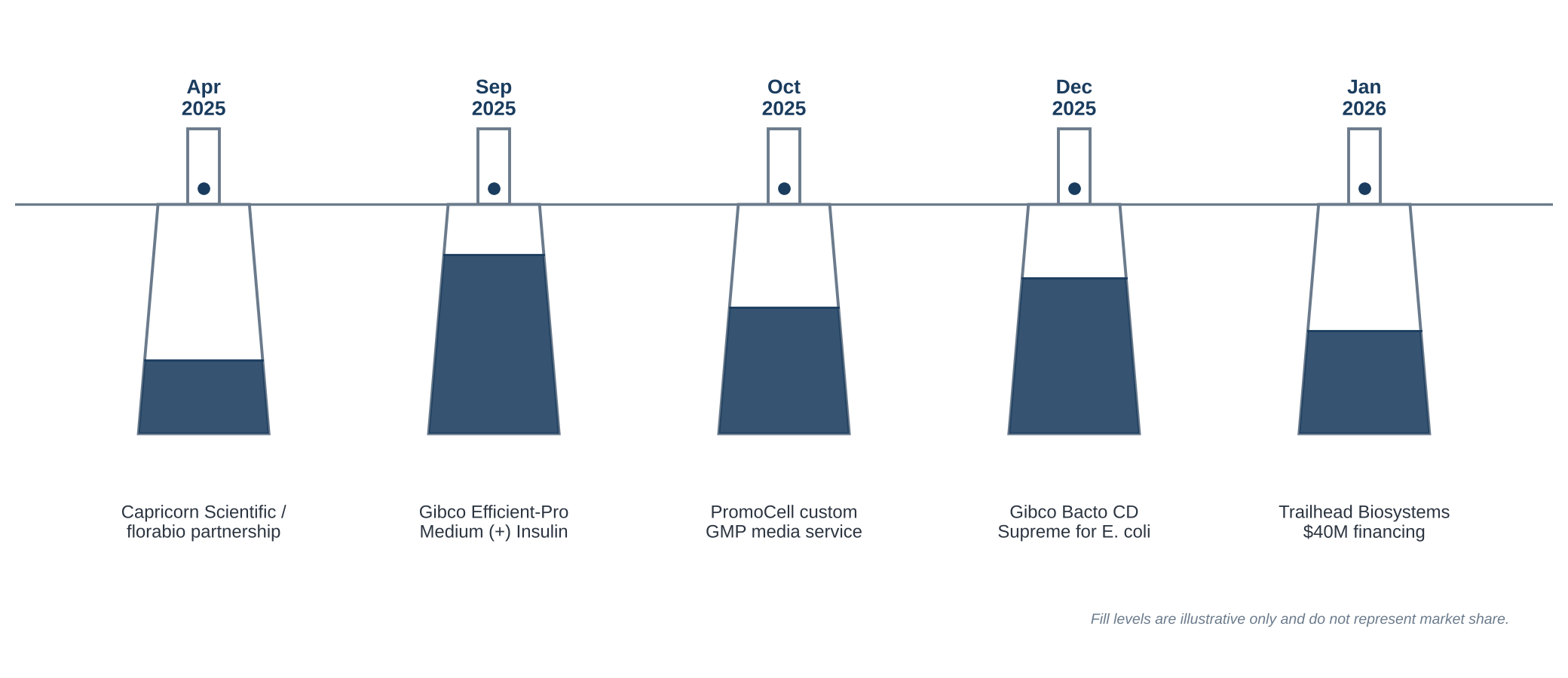
Figure 1. Selected dated developments in serum-free and chemically defined cell culture media, April 2025 through January 2026. Fill levels are illustrative only. Source: company and industry announcements cited throughout this article.
Smaller Suppliers Are Choosing Narrower Ground
Not every supplier is trying to cover every cell type. In April 2025, Capricorn Scientific partnered with florabio to combine animal-free formulation expertise with florabio's high-yield expression system work, with the companies saying joint products had already launched and more were planned through the rest of 2025. In October 2025, PromoCell moved in a different direction, launching Custom GMP Cell Culture Media Services to extend its existing media business into regulatory-grade manufacturing specifically for cell and gene therapy customers, debuting the service at the European Society of Gene and Cell Therapy Congress in Seville.
Both moves target a narrower slice of the market than a general-purpose CHO or E. coli medium: Capricorn and florabio on animal-free formulation performance, and PromoCell on the regulatory and manufacturing-grade requirements that cell and gene therapy customers need but that a catalog product does not automatically satisfy.
| Date | Development | Category |
|---|---|---|
| Apr 2025 | Capricorn Scientific and florabio partner on animal-free media | Partnership |
| Sep 2025 | Thermo Fisher launches Gibco Efficient-Pro Medium (+) Insulin | Product Launch |
| Oct 2025 | PromoCell launches Custom GMP Cell Culture Media Services | Service Launch |
Source: Biopharma Boardroom (Apr 22, 2025); BusinessWire (Sep 15, 2025); Indian Pharma Post (Oct 7, 2025).
Investors Are Still Backing Stem Cell Media Specifically
Trailhead Biosystems, which differentiates induced pluripotent stem cells into functional human cell types and sells both cells and media products, added $20 million in extension funding in January 2026, led by MAK Capital, bringing its total financing since a May 2025 round to $40 million. The company said the funding would support commercialization of its iPSC-derived cell and media products for preclinical research applications including toxicity testing and disease modeling.
Stem cell and iPSC-focused media remains a smaller category than CHO-focused media tied to established biologics manufacturing, but continued investor interest suggests the category is expected to grow alongside the broader build-out of cell therapy and regenerative medicine manufacturing.
What to Watch
Three threads are worth tracking into the rest of 2026: whether Thermo Fisher continues extending chemically defined formulations into additional cell types and manufacturing modes, whether PromoCell's move into GMP-grade media services draws similar moves from other catalog media suppliers, and whether continued funding for stem cell and iPSC media specialists like Trailhead Biosystems translates into meaningful commercial volume as cell therapy manufacturing scales.
Serum-Free Cell Culture Media Market Report: Size, Share & Trends 2026–2035
This article provides editorial and R&D context only. For full market sizing, segmentation, regional share, competitive benchmarking and forecasts through 2035, see the companion Serum-Free Cell Culture Media Market report.
Get a free sample of this report
Serum-Free Cell Culture Media Market