

Tissue Engineering Has Two Competing Playbooks: Grow a Replacement, or Build a Scaffold the Body Finishes
From a broadened bone graft clearance to two very different vascular and skin funding rounds, the products reaching patients in 2025 and 2026 split cleanly between cell-based tissue and synthetic scaffolds the body remodels on its own.
Tissue engineering spans a wide range of approaches, from fully synthetic scaffolds to personalized living grafts grown from a patient's own cells. The more interesting story across 2025 and into 2026 is not which approach is winning, since both are attracting serious capital and regulatory progress, but how clearly the field is splitting into two distinct playbooks. This article sets the market-sizing numbers in our companion report aside and looks at what has actually been cleared, funded, acquired, and launched.
The Synthetic Scaffold Playbook Gets a Wider Net
In July 2025, SurGenTec received expanded FDA clearance for OsteoFlo HydroFiber, a synthetic bone graft, broadening its approved use to bone defects from tumors, cysts, trauma, and osteomyelitis, on top of its existing spine indications. The product does not contain living cells. Instead, its fiber structure and hydrophilic design let it absorb the patient's own blood or bone marrow aspirate on site, giving surgeons a synthetic alternative to harvesting bone from elsewhere in the patient's body.
A widening indication for an already-cleared synthetic product is a lower-risk way to grow a tissue engineering business than developing a new cell-based therapy from scratch, since it builds on safety data the product has already generated rather than starting a new regulatory and clinical path.
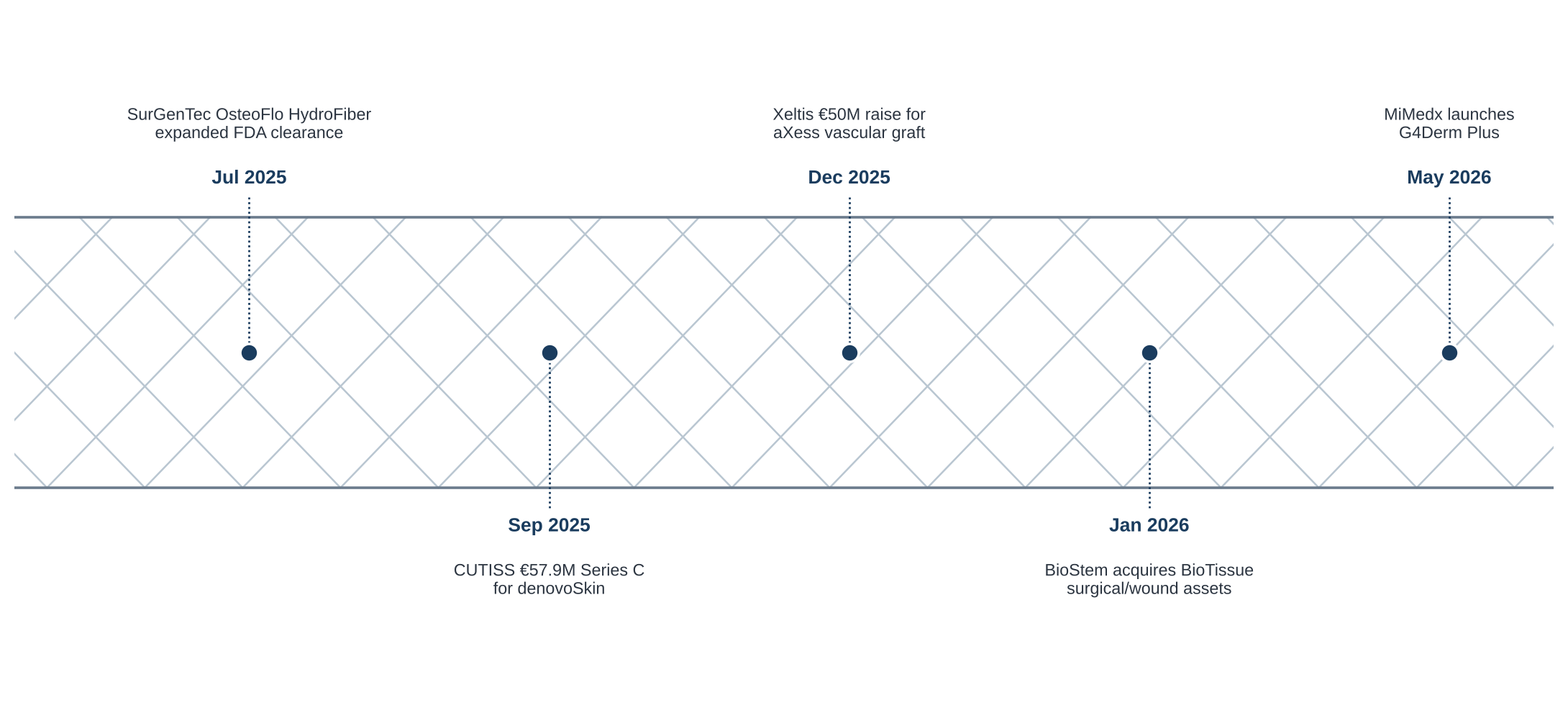
Figure 1. Selected dated developments in tissue engineering, July 2025 through May 2026. Source: company and industry announcements cited throughout this article.
Two Very Different Bets on Replacing a Blood Vessel or Skin
CUTISS and Xeltis both raised significant funding in the second half of 2025, and both are working on replacing damaged tissue, but their underlying approaches could hardly be more different. CUTISS closed a €57.9 million Series C for denovoSkin, a personalized skin graft grown from a patient's own cells and currently in Phase 3 trials. Xeltis raised about €50 million for aXess, a synthetic, bioresorbable vascular access scaffold for hemodialysis patients that is designed to dissolve as the body forms its own living vessel in its place.
CUTISS is building a living product directly; Xeltis is building a temporary structure and letting the body do the rest. Both raised comparable amounts in the same several-month window, suggesting investors are not betting on one approach over the other so much as on strong clinical data and a credible path to market within each company's chosen category.
| Date | Development | Category |
|---|---|---|
| Jul 2025 | SurGenTec wins expanded FDA clearance for OsteoFlo HydroFiber | Regulatory Clearance |
| Sep 2025 | CUTISS raises €57.9M Series C for denovoSkin | Funding |
| Dec 2025 | Xeltis raises €50M for aXess vascular graft | Funding |
Source: OrthoSpineNews (Jul 22, 2025); Parsers.vc (Sep 11, 2025); Citeline Medtech Insight (Dec 10, 2025).
Consolidation and New Launches in Biologically Derived Products
The biologically derived side of the market kept moving too. In January 2026, BioStem Technologies agreed to acquire BioTissue Holdings' surgical and wound care business for up to $40 million, adding cryopreserved amniotic membrane allografts for both wound care and surgical repair to its existing product line. In May 2026, MiMedx launched G4Derm Plus, an acellular extracellular matrix product built on self-assembling peptide technology rather than donor tissue, distributed through major hospital group purchasing organizations for rapid national reach.
Together these moves show established wound care and surgical tissue companies both acquiring complementary product lines and launching newer scaffold technologies, rather than relying on a single product category to carry their growth.
What to Watch
Three threads are worth tracking into the rest of 2026: whether CUTISS's denovoSkin reads out positive Phase 3 data and moves toward regulatory filing, whether Xeltis's aXess gains EU clearance and early US traction under the new CMS dialysis access guidelines, and whether more bone graft and wound care companies pursue the same expanded-indication strategy SurGenTec has used to grow an already-cleared synthetic product.
Tissue Engineering Market Report: Size, Share & Trends 2026–2035
This article provides editorial and R&D context only. For full market sizing, segmentation, regional share, competitive benchmarking and forecasts through 2035, see the companion Tissue Engineering Market report.
Get a free sample of this report
Tissue Engineering Market