

Two Radiology Deals in Ten Weeks Show Where Telemedicine Money Is Really Going
While Washington moves to tighten how remote monitoring gets paid for, two of the largest imaging companies in the country just spent a combined nine figures buying their way into teleradiology. The technology side of telemedicine is consolidating around where specialist shortages are worst, not around where consumer demand is loudest.
It is easy to think of telemedicine technology as a single, roughly uniform category defined by the COVID-era video visit. The platforms and devices actually being bought, funded, and regulated in 2025 and 2026 tell a more specific story. The biggest moves are concentrated in tele-radiology consolidation, AI features layered onto existing hospital platforms, and a regulatory fight over how remote monitoring gets reimbursed. This article sets the market-sizing numbers in our companion report aside and looks at what has actually been moving.
Two Teleradiology Deals, Ten Weeks Apart
In August 2026, Radiology Partners agreed to acquire Everlight Radiology, an international tele-radiology provider with more than 800 radiologists across the UK, Ireland, Australia, New Zealand, and South Africa, combining it with its existing vRad unit, already the largest tele-radiology platform in the United States. Ten weeks later, RadNet announced its own tele-radiology move, agreeing to acquire Onrad for up to $560 million including earnout payments, creating an entirely new business line the company calls Radiology Professional Services.
Both companies gave essentially the same reason: a persistent, worsening shortage of radiologists relative to imaging volume. Tele-radiology lets a smaller pool of specialists cover more locations and more hours, including overnight and weekend reads that would otherwise sit in a queue. Two large, independent imaging companies reaching for the same solution within ten weeks of each other is a clearer signal about where specialist capacity is most strained than either deal would be on its own.
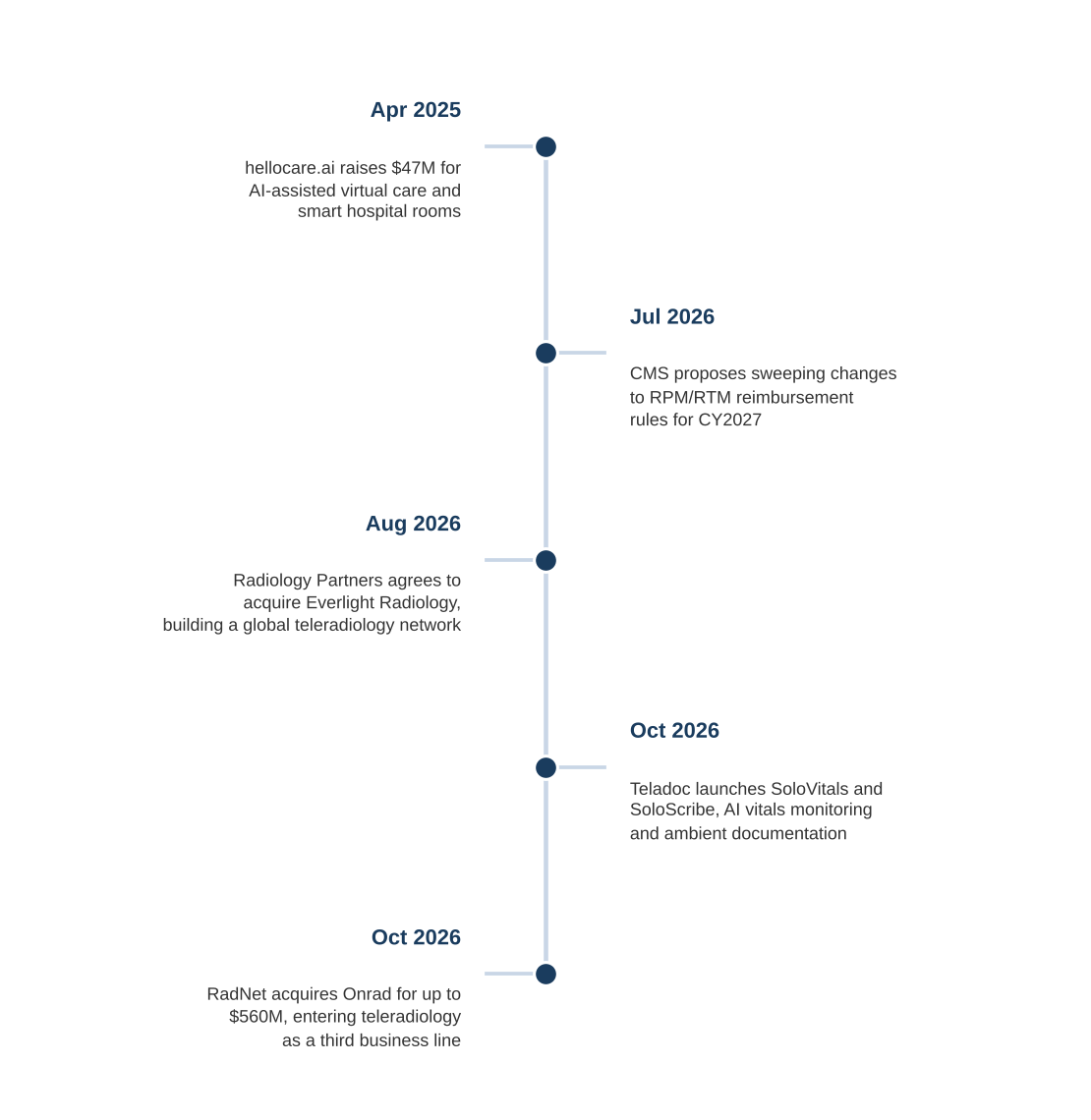
Figure 1. Selected dated developments in telemedicine technology, April 2025 through October 2026. Source: company and regulator announcements cited throughout this article.
Washington Is Moving the Other Direction on Remote Monitoring
At almost the same time the teleradiology deals were taking shape, CMS proposed a very different kind of change for remote patient and remote therapeutic monitoring. Its July 2026 proposed rule would require that monitoring staff be direct employees of the billing practice, not third-party vendor staff, and could collapse 17 existing billing codes down to just four. CMS pointed to a federal oversight finding that a significant share of billed remote monitoring services were incomplete as the reason for tightening the rules.
The practical effect, if finalized, falls hardest on vendors whose business model depends on supplying monitoring staff to practices on a contract basis, rather than on vendors that simply sell monitoring software and devices outright. It is a useful reminder that regulatory risk in this market often sits in the reimbursement mechanics, not in the underlying clinical technology itself.
| Date | Development | Category |
|---|---|---|
| Aug 2026 | Radiology Partners agrees to acquire Everlight Radiology | Acquisition |
| Oct 2026 | Teladoc launches SoloVitals and SoloScribe AI features | Product launch |
| Oct 2026 | RadNet acquires Onrad for up to $560M | Acquisition |
Source: Business Wire (Aug 25, 2026); Teladoc Health (Oct 7, 2026); MedTech Dive (Oct 26, 2026).
AI Is Arriving as an Add-On, Not a New Product Category
Teladoc's October 2026 expansion of its Solo Connected Care Platform, adding SoloVitals for contactless vitals monitoring and SoloScribe for ambient clinical documentation, follows a pattern showing up across the market. Rather than selling AI capability as a standalone product that a hospital has to separately evaluate and integrate, established platform vendors are layering AI features onto relationships hospitals already have, lowering the adoption barrier considerably compared with a brand-new point solution.
That pattern also shows up on the investment side. hellocare.ai's $47 million funding round in April 2025 was backed in part by health systems themselves, including Bon Secours Mercy Health and UCHealth, rather than purely financial investors. Hospitals investing directly in the technology meant to extend virtual nursing and monitoring coverage suggests they see it as solving a direct staffing problem, not simply as a patient convenience feature.
What to Watch
Three threads from 2025 and 2026 are worth tracking into next year: whether the CMS remote monitoring rule survives the comment process in anything close to its proposed form, whether the Radiology Partners and RadNet teleradiology acquisitions trigger a third large deal from a competitor trying to keep pace, and whether AI features like SoloVitals and SoloScribe meaningfully change how hospitals staff monitoring and documentation work, or simply get added to existing workflows without shifting headcount.
Telemedicine Technologies Market Report: Size, Share & Trends 2026–2035
This article provides editorial and R&D context only. For full market sizing, segmentation, regional share, competitive benchmarking and forecasts through 2035, see the companion Telemedicine Technologies Market report.
Get a free sample of this report
Telemedicine Technologies Market