

In Wearable Cardiac Monitoring, the Sensor Isn't the Risk Anymore. The Software Is.
A software bug, not a faulty sensor, triggered the most serious recall in wearable cardiac monitoring in years. Meanwhile, a long-running patent fight ended quietly in Apple's favor, and fresh money kept flowing toward wearables built for clinical detail rather than consumer convenience.
Wearable cardiac monitoring has largely solved the hardware problem. Patches, smartwatches, and Holter monitors reliably capture ECG signal over days or weeks without much fuss. What 2025 and 2026 have shown is that the harder problems now sit elsewhere: in the software that interprets what the sensor records, in the intellectual property fights between platform companies and smaller device makers, and in how much clinical detail a wearable needs to offer to stand out. This article sets the market-sizing numbers in our companion report aside and looks at what has actually been moving.
A Software Bug, Not a Bad Sensor, Caused the Year's Most Serious Recall
In January 2025, the FDA classified a recall of Philips' Mobile Cardiac Telemetry Monitoring service and its BTPS-1000 wearable sensor patch as Class I, its most serious category. The cause was not a hardware defect. A software configuration issue caused some ECG recordings between July 2022 and July 2024, including atrial fibrillation, pauses, and dangerous heart blocks, to go unflagged for clinician review. The FDA received reports of 109 injuries and two deaths linked to the issue.
The patch itself worked. It recorded the data it was supposed to record. The failure happened in the software layer that was supposed to flag abnormal findings for a clinician to act on, a reminder that as wearable cardiac monitoring leans more heavily on automated analysis, software validation and post-market monitoring carry as much clinical weight as the sensor design itself.
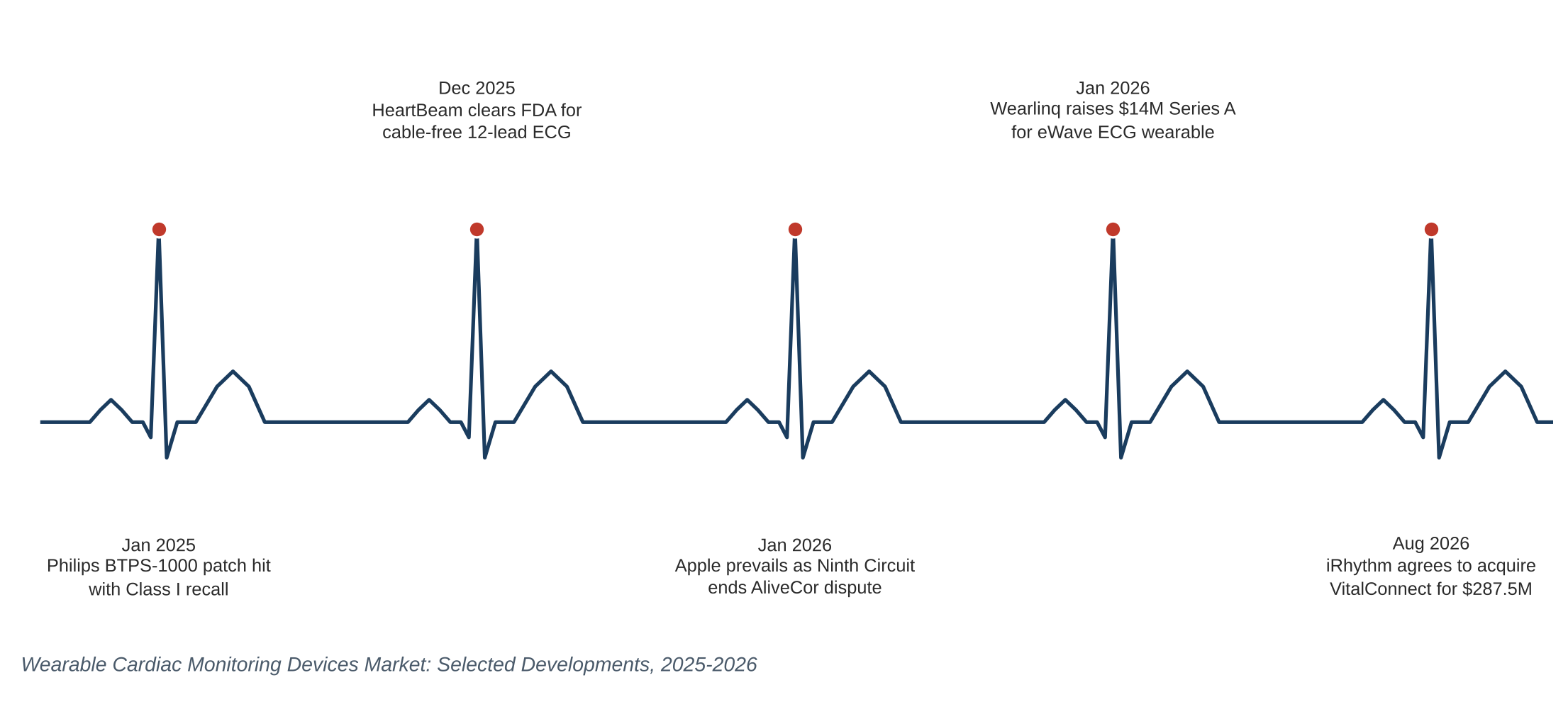
Figure 1. Selected dated developments in wearable cardiac monitoring devices, January 2025 through August 2026. Source: company, regulatory, and legal announcements cited throughout this article.
Apple Wins, Quietly, After Years of Fighting AliveCor
In January 2026, the Ninth Circuit Court of Appeals affirmed summary judgment in Apple's favor, rejecting AliveCor's claim that Apple illegally monopolized the market for heart rhythm analysis apps on the Apple Watch. The ruling followed a March 2025 decision that had already confirmed the invalidation of three AliveCor patents at the center of the dispute, effectively closing out years of patent and antitrust litigation over Apple Watch ECG features.
The outcome is a useful data point for smaller device makers competing against platform companies with built-in ECG capability: AliveCor's patents did not survive the legal process, and its antitrust theory failed once the patents were gone. Competing on features that a dominant platform can plausibly build itself carries real legal and commercial risk, independent of how strong the original product innovation was.
| Date | Development | Category |
|---|---|---|
| Dec 2025 | HeartBeam clears FDA for cable-free 12-lead ECG | Regulatory Clearance |
| Jan 2026 | Ninth Circuit ends Apple-AliveCor dispute in Apple's favor | Legal |
| Aug 2026 | iRhythm agrees to acquire VitalConnect for $287.5M | Acquisition |
Source: Reuters (Dec 10, 2025); MacTech (Jan 8, 2026); HLTH Insights (Aug 11, 2026).
The New Pitch Is Clinical Detail, Not Convenience
Two smaller funding and product stories point to where device makers think the next competitive edge sits. Wearlinq raised a $14 million Series A, plus $5 million in venture debt, for its eWave continuous wireless 6-lead ECG wearable, well beyond the single-lead readings most consumer smartwatches offer. HeartBeam, separately, won FDA clearance for a cable-free system that synthesizes a full 12-lead ECG at home, matching the diagnostic detail of an in-clinic ECG rather than a simplified consumer screening tool.
At the larger end of the market, iRhythm's agreement to acquire VitalConnect for roughly $287.5 million follows the same logic at a different scale. VitalConnect's 4-in-1 biosensor platform tracks up to 11 physiological parameters across inpatient, outpatient, and hospital-to-home settings, extending iRhythm's existing long-term ECG monitoring business into higher-acuity, multi-parameter monitoring rather than simply adding more volume to its existing Zio platform.
What to Watch
Three threads are worth tracking into the rest of 2026: whether other wearable cardiac monitoring vendors face software-related safety findings similar to Philips's, whether more multi-lead and higher-acuity wearables reach the market following HeartBeam's and Wearlinq's lead, and whether iRhythm's VitalConnect acquisition prompts similar acuity-spanning consolidation moves from competitors.
Wearable Cardiac Monitoring Devices Market Report: Size, Share & Trends 2026–2035
This article provides editorial and R&D context only. For full market sizing, segmentation, regional share, competitive benchmarking and forecasts through 2035, see the companion Wearable Cardiac Monitoring Devices Market report.
Get a free sample of this report
Wearable Cardiac Monitoring Devices Market